


In a real industrial environment, the metal shredding process is not a simple “feed and cut� operation, but a tightly coordinated mechanical workflow where material behavior, equipment load, and separation efficiency are all interdependent. The process begins not with the shredder itself, but with how scrap behaves under stress. Different metals deform, fracture, or resist cutting in very different ways, and this directly determines how the process must be structured.
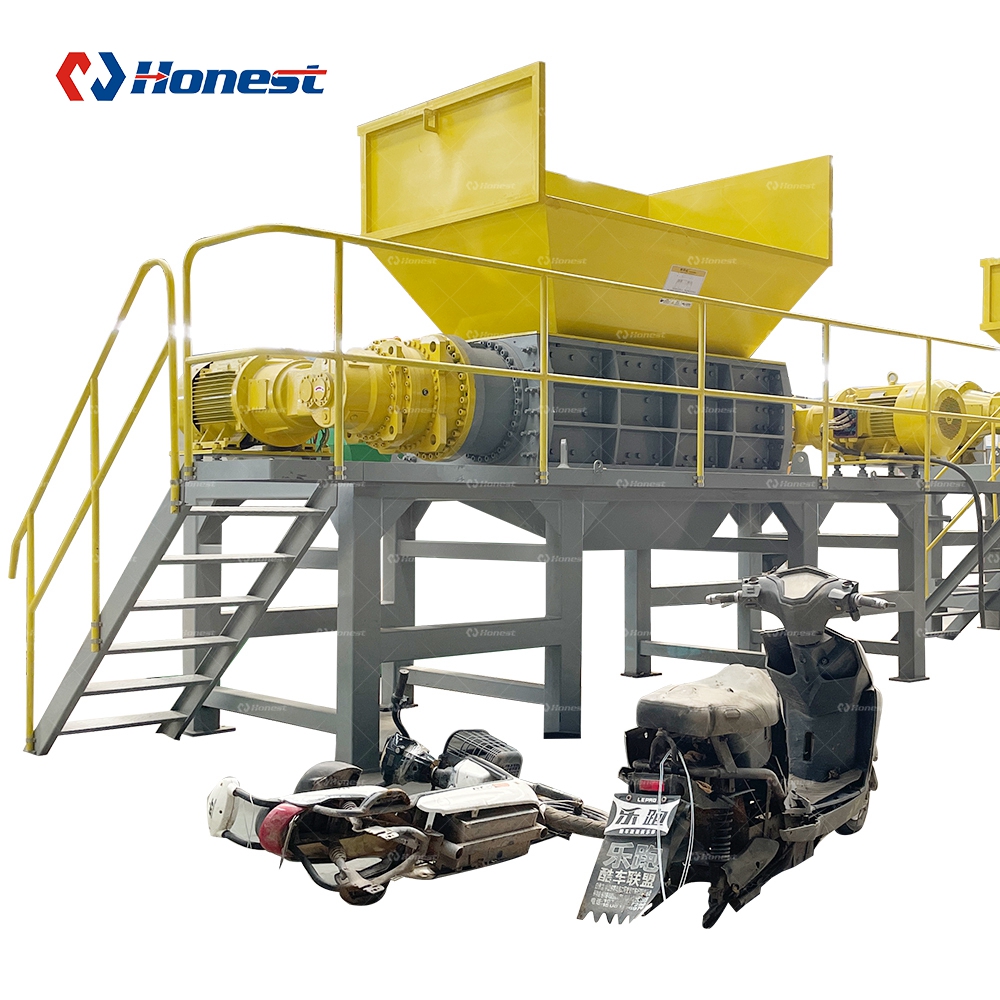
When scrap enters the system, the first transformation is not size reduction but stress distribution. Large and irregular metal pieces are subjected to compressive and torsional forces inside the shredder chamber. In a dual shaft configuration, the cutters do not “cut� in a traditional sense but create opposing force vectors that pull and tear the material apart. This is particularly important for mixed scrap, such as appliances or automotive shells, where multiple materials are physically bonded together. The goal at this stage is not fine-size reduction but structural disintegration.
After initial tearing, the material enters a transitional state where liberation begins. Liberation is the most critical concept in metal recycling. It refers to the point at which different materials—steel, aluminum, copper, plastics—are no longer physically attached. If shredding is too aggressive early on, valuable metals can be lost as fines. If it is too weak, downstream systems cannot separate materials effectively. This balance is why industrial lines often use staged reduction rather than a single machine.
Separation does not occur as a single step but as a layered process embedded throughout the line. Magnetic extraction may begin immediately after primary shredding, removing liberated ferrous metals early to reduce load on downstream equipment. Non-ferrous separation is delayed until the particle size is sufficiently uniform, because eddy-current systems require consistent geometry to operate efficiently.
The metal shredding process is best understood not as a sequence of steps, but as a controlled progression from structural breakdown to material liberation to precision separation. Facilities that treat it as a dynamic system rather than a fixed workflow consistently achieve higher recovery rates and lower operating costs.
Henan Honest Heavy Machinery : http://www.honestshredder.com/,All rights reserved。
Welcome to visit Henan Honest website. If you want to learn more about our equipments, Contact us Now to find out what we can do for you next project!